Posts

Showing posts with the label Physics

Photoelectric Effect: The Quantum Nature of Light

Image
Photoelectric Effect: The Quantum Nature of Light Introduction The photoelectric effect is the phenomenon in which light incident on a metal surface causes the emission of electrons from the material. This effect provided crucial evidence for the particle nature of light , challenging classical wave theories and paving the way for quantum mechanics . Albert Einstein’s explanation of the photoelectric effect introduced the concept of photons —discrete packets of light energy—leading to his Nobel Prize in 1921 . This discovery has since been fundamental to technologies such as solar cells, photodetectors, and quantum optics . Key Observations of the Photoelectric Effect Instantaneous Emission: Electrons are ejected immediately when light of sufficient frequency strikes the metal surface. There is no time lag , even if the light intensity is low, contradicting classical wave theory predictions. Threshold Frequency (𝑓₀): There exists a minimum frequency f 0 f_0 belo...

Comparison of Key Electromagnetic & Newtonian Laws - Compiled By BILRED

Image
  Comparison of Key Electromagnetic & Newtonian Laws Law/Effect Formula/Equation Key Variables & Meaning What It Describes/Applies To Similarities/Differences Coulomb’s Law  (Electric Force) F = k q 1 q 2 r 2 -  F : Electric force (N) -  k : Coulomb constant  9 × 10 9  Nm²/C² -  q 1 , q 2 : Charges (C) -  r : Distance (m) Describes the force between two point charges. Similar to Newton’s gravitational law but for electrostatics. Inverse Square Law:  Like gravity but for electric charges. Electric Field ( E ) E = F q = k Q r 2 -  E : Electric field (N/C) -  Q : Source charge (C) -  r : Distance (m) Defines the field created by a charge and the force it exerts on another charge. Like gravitational field ( g ) , but for electric forces. Gauss’s Law (Electric Fields) ∮ E ⋅ d A = Q enc ε 0 -  E : Electric field (N/C) -  d A : Surface area element (m²) -  Q enc : Enclosed charge (C) Relates the total electric f...

Electric Field – Definition & Related Phenomena - Basic Knowy - Compiled By Bilal Ahmad Khan AKA Mr. BILRED

Image
Electric Field – Definition & Related Phenomena Definition: An electric field is a region around a charged object where other charged objects experience a force. It is represented by the symbol E and is defined as the force per unit charge: E = F / q where F is the force acting on a test charge q. Units: The SI unit of the electric field is Newton per Coulomb (N/C) or Volt per meter (V/m). Direction: The direction of the electric field is away from positive charges and towards negative charges. Key Equations: For a point charge: E = (kQ)/r^2  where k is Coulomb’s constant. For a uniform field: E = V/d where V is voltage and d is distance. png-clipart-point-electric-field-field-line-electric-charge-three-dimensional-effect-angle-white.png (900×446) Extended Concepts Pyroelectricity(Heat/Cool): Definition: Certain materials generate an electric charge when heated or cooled due to asymmetric crystal structures. How It Works: When temperature changes, the internal structure of the...

Solenoid Magnetic Field & Induced EMF Simple Numericals - Compiled By Bilal Ahmad Khan AKA Mr. BILRED

Image
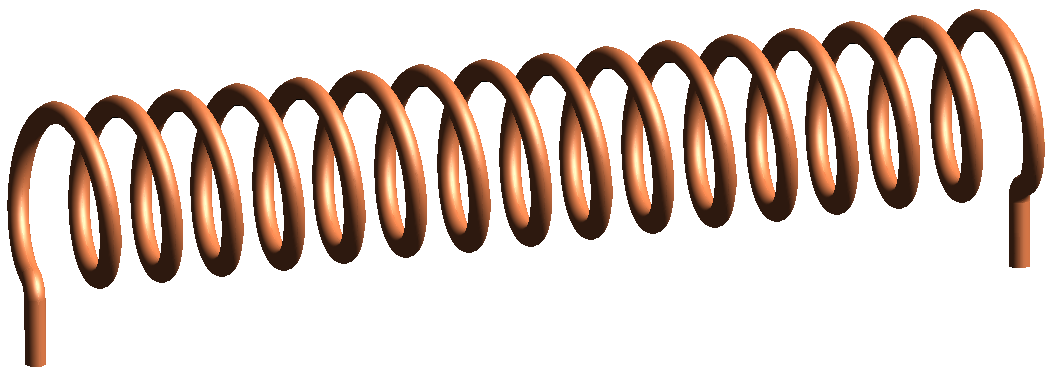
Solenoid-1.png (1060×376) What is a Solenoid? A solenoid is a coil of wire wound in a cylindrical shape that generates a magnetic field when an electric current passes through it. It acts like an electromagnet and is commonly used in motors, relays, and inductors. What is Induced EMF? Electromotive Force (EMF) is the voltage generated when the magnetic flux through a coil changes. According to Faraday’s Law , a changing magnetic field induces an EMF, which is the principle behind transformers and electric generators. QUESTIONS (Try to solve these at your own first): 1.       A solenoid 1.30 m long and 2.60 cm in diameter carries a current of 18.0 A . The magnetic field inside the solenoid is 23.0 mT . Find the total length of the wire used to form the solenoid. 2.       A solenoid has 2000 turns uniformly wound over a length of 50 cm . If it carries a current of 5 A , find the...